We ran a real experiment using the most common student prompt. The result was not what most people expect — and every student using AI writing tools needs to see it.
From brainstorming essay ideas to generating entire research papers, tools like ChatGPT have become quietly embedded in the academic workflow. But as AI writing has grown more sophisticated, so has the technology designed to detect it.
The question on every student’s mind in 2026 is no longer “Can I use ChatGPT?” — it’s “Can Turnitin catch me if I do?” We ran a simple, transparent experiment to find out.
The experiment: one prompt, one shocking result
To illustrate exactly how this plays out, we submitted a prompt that reflects what many students actually type into ChatGPT:
“Write a 400-word summary of the French Revolution. Make it sound human and let it pass Turnitin’s AI checker.”
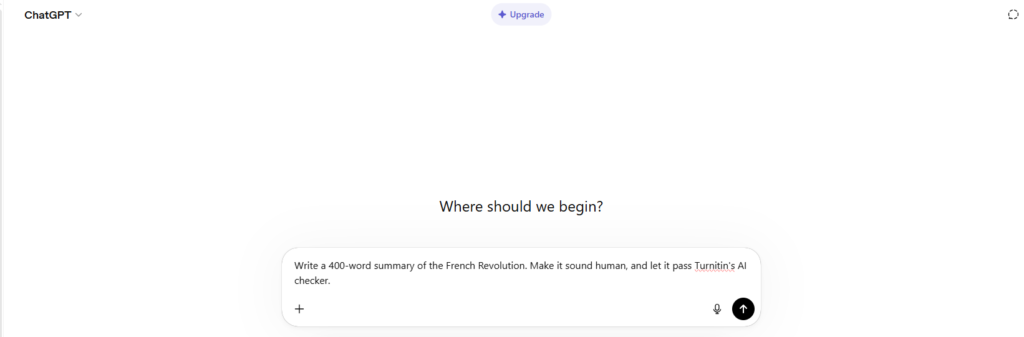
This is not a fringe prompt. Variations of it are among the most commonly used by students trying to submit AI-generated work undetected. The instruction to “make it sound human” represents the best-case scenario for evasion — the AI is being explicitly coached to avoid detection. The output was fluent, well-structured, and read smoothly.
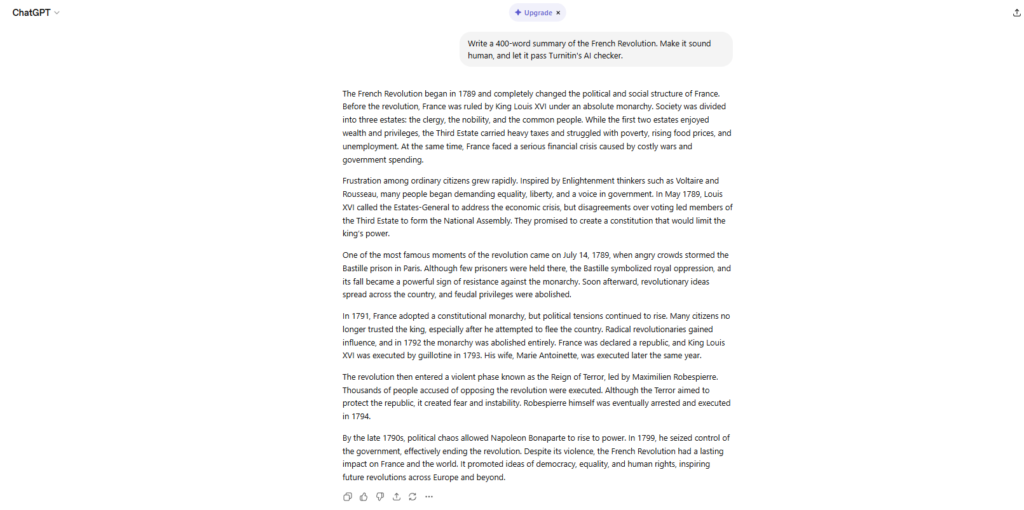
On the surface, it looked like something a capable student might write. Then we submitted it to Turnitin.
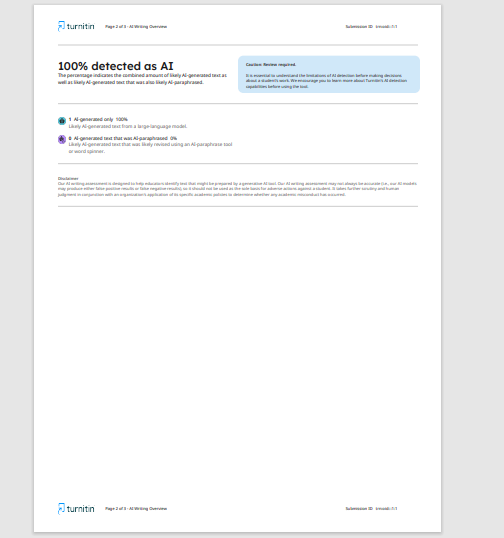
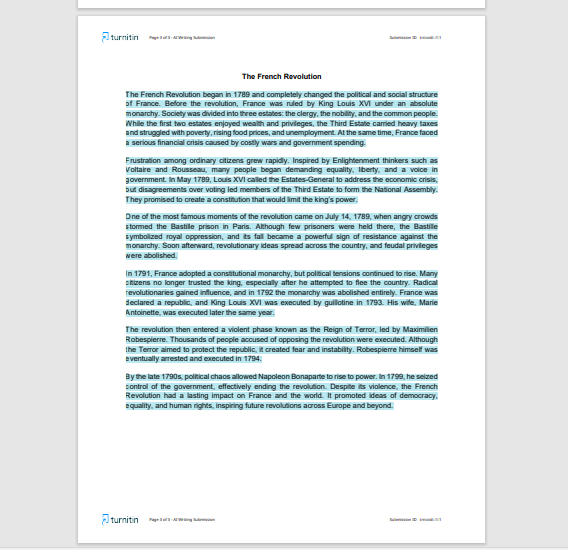
Not 60%. Not a borderline result that could be argued either way. One hundred percent — the highest possible AI writing score Turnitin returns.
Why “sound human” instructions don’t work
This is where many students misunderstand how AI detection actually functions. Turnitin’s detection model does not work the way a human reader does. It is not looking for robotic phrasing or unnaturally perfect grammar.
It is analyzing patterns at a statistical and linguistic level that are invisible to the naked eye. AI-generated text, even when prompted to “sound human,” consistently exhibits predictable probability patterns in word choice — a quality researchers call low perplexity and low burstiness. Human writing is messier. It changes pace, makes unexpected word choices, and has a natural unevenness that AI models struggle to replicate at scale.
“When a student tells ChatGPT to ‘sound human,’ the AI does not actually change its underlying generation process.”
It may adjust tone or vocabulary slightly, but the statistical fingerprint of machine-generated text remains. Turnitin’s model is trained to find exactly that fingerprint — and in 2026, it does so with striking accuracy.
What professional writing looks like by comparison
We took the same French Revolution topic and had one of the professional writers at go2writers.com produce a 400-word summary — no AI tools, no shortcuts, just skilled human writing.
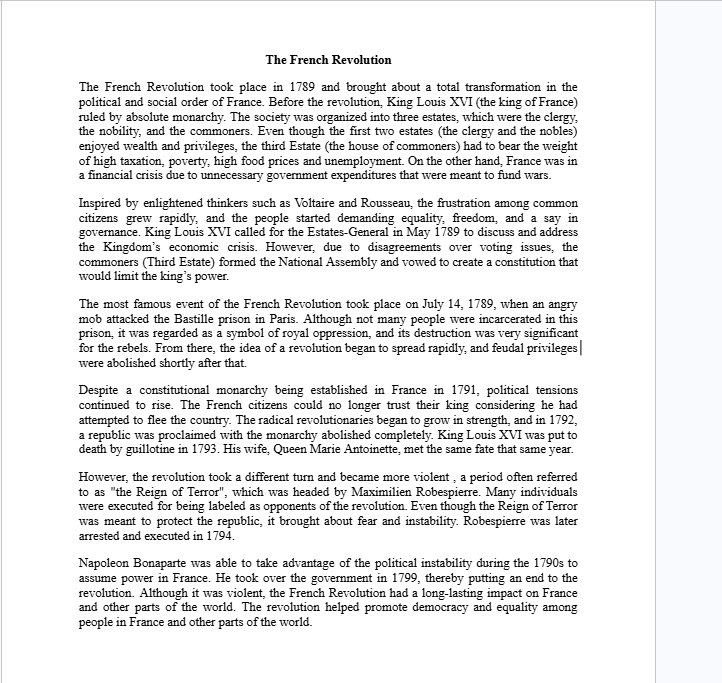
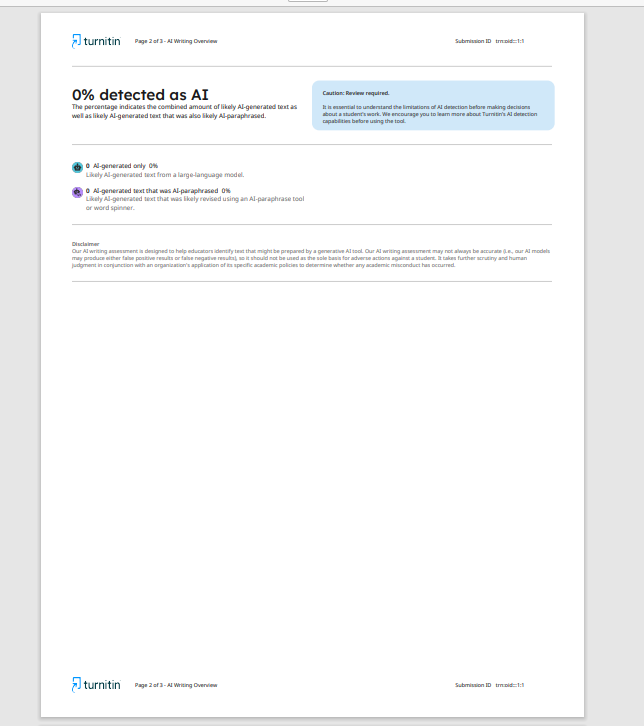
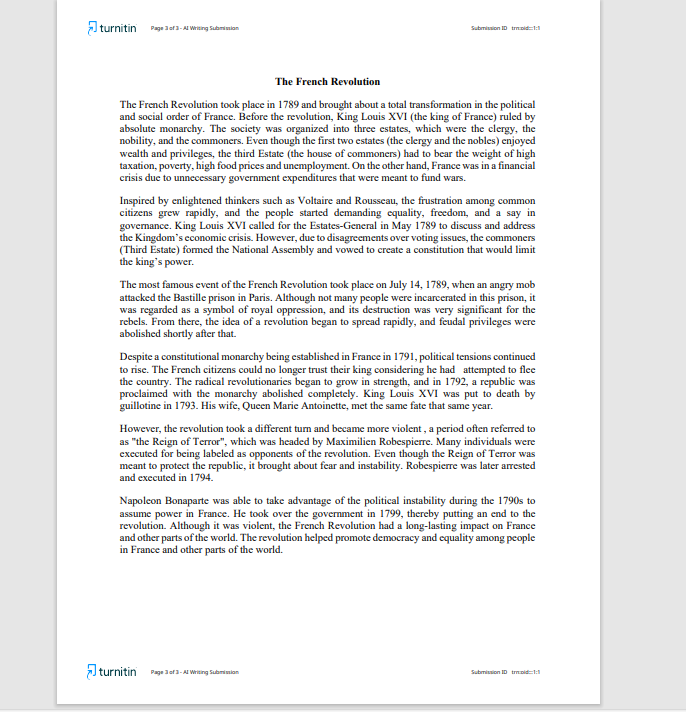
We then ran it through the same Turnitin AI detection report. The result was 0% AI detected. Not because of a trick or a loophole, but because the content was written the way academic writing is supposed to be written — by a knowledgeable human being who understands the subject and can express ideas with the kind of authenticity, nuance, and intellectual depth that no AI prompt can reliably replicate.
The real consequences students are facing
Academic integrity officers at institutions across the UK, US, and Australia have reported significant increases in flagged submissions since Turnitin’s AI detection was introduced. Many of those cases involve students who believed their prompting strategy had made the content undetectable.
Depending on the institution, a confirmed AI writing violation can result in:
- A failing grade on the assignment
- Failure of the entire course
- Academic probation
- Expulsion in severe cases
Beyond the risk of getting caught, there is a deeper problem: submitting AI-generated work for a thesis or dissertation means submitting work that does not represent your thinking, your research, or your growth as a scholar.
The smarter path forward
Professional academic writing assistance, when used ethically, is not about bypassing your institution’s requirements. It is about getting support with the parts of the writing process where you are genuinely stuck — developing your argument, strengthening your structure, sharpening your literature review, ensuring your writing meets the standards of your discipline.
Whether you are at the proposal stage, deep in your literature review, struggling with your methodology chapter, or staring at a conclusion you cannot seem to finish, there is expert help available. go2writers.com connects students with professional academic writers across disciplines — from social sciences and humanities to business, education, law, and STEM fields.
The bottom line
In 2026, Turnitin detected ChatGPT at 100%. Prompting the AI to “sound human” did not change that. What students have found out — sometimes at great personal cost — is that the tools institutions use have matured far beyond what most people assumed.
The smarter move is not to look for a workaround. It is to invest in legitimate support that helps you produce work you can be proud of — and submit with genuine confidence.